
On Waiting For Spring
The Essay In The Age Of AI, Writing After Chat GPT, The Novel, Plus Some Favorite Poems, Stories And Essays

Two announcements up front: This Wednesday, I will be on a panel on the personal essay in the age of AI at Bennington College, along with some favorite writers—Joanne Beard, Franny Choi and Anaïs Duplan. It’s the Bennington Ben Belitt Colloquium, 7PM-8:30PM at Tishman on the Bennington campus, or available also by Zoom at that link.
And the brilliant novelist and critic Garth Greenwell has made some of his recent classes available as recordings, including his 4-part series on my debut novel, Edinburgh. I make an appearance in the final class. It was such an honor, is such an honor, to be the subject of his scholarly inquiry. His two other offerings at present are on Another Country, by James Baldwin, and Mysticism for Writers.
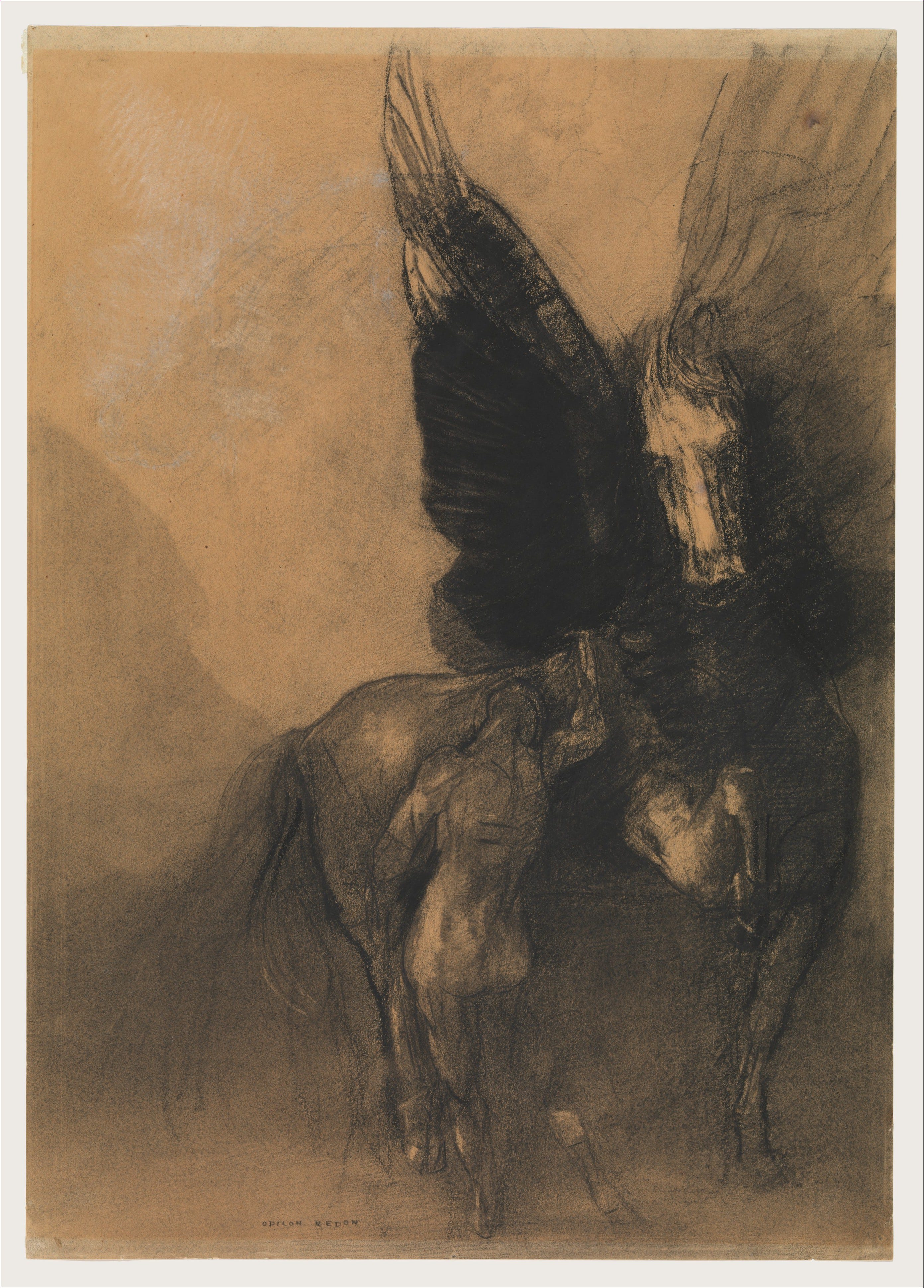
Pegasus and Bellerophon, by Odilon Redon, Met Open Access
I.
It is spring break this week at my college though it feels more like spring broken here in Vermont—it snowed over the weekend in an absent-minded way, like the snow had forgotten how to be snow. I don’t really take the snow tires off until May up here. This brief respite between our winter and spring terms doesn’t feel like a vacation to me and it never really does. I am working to finish my new novel anyway, and I suppose it is not really a break for professors anywhere. Even when I’m not finishing a novel I’m not much for getting away during this two week period over the last decade. And if I had made plans of that kind for this week I would be facing ICE agents at the airport.
I am rethinking what I will offer my students in my first year writing seminar this spring. Up for consideration is this new essay from my friend Lucy Ives, her first of six columns for The Believer about creative writing after Chat GPT. I think it’s perfect for introducing the problem.
Approximately two years ago, although it seems like yesterday, a student of mine in a creative writing course performed an experiment.
The experiment was technology related.
I was its subject.
Instead of writing the short prose pieces all participants in the class were assigned, the student used a popular large language model (LLM) he’d accessed online to generate a gappy text he presented as his own unassisted work.
The syllabus stated unambiguously that this wasn’t allowed: You could use an LLM but you had cite the model explicitly. (The student had been present when the syllabus was distributed and read out loud.) During the second-to-last (or nearly) week of classes, he admitted that he’d used “AI” to write his previous submissions. He contended that because I seemed not to have noticed, this proved that literature was an outmoded construct we’d all do well to be less deceived by.
I will probably send this to my fellow panelists. Lucy has a new book out in May on writing called Three Six Five: Prompts, Acts, Divinations (An Inexhaustible Compendium For Writing). I like it because it makes explicit much of what is at stake in the teaching in ways many of these arguments do not.
I will pair that column with this essay by Michael Geoffrey Asia, “The Labor Behind AI Intimacy,” about the very real people paid almost nothing in countries across Africa for their labor in those chats with users who imagine they are having sexts with a computer intelligence. They aren’t, it seems, and the reason it feels like a human responding is that it is a human responding. A badly paid human who is being traumatized by the trade-off of hiding the interaction as being done with an AI.
As for my advanced fiction class, and perhaps yours, the novelist and critic Kaitlyn Greenidge, the Features Director at Harper’s Bazaar and the force behind the Harper's Bazaar's A Closer Read books newsletter, has produced a massive books feature in the current issue, with interviews with Margaret Atwood, Otessa Moshfegh, Jumpa Lahiri, Jesmyn Ward and Joyce Carol Oates, as a part of a look at “what it takes to write something true.” Both the newsletter and this new feature are tremendous gifts. Greenidge writes
You could argue that we are currently in the middle of what looks to be a very disheartening story. I am overwhelmed these days by what feels like the futility of narrative. Narrative is the way we organize reality, how we understand ourselves and the people around us and, most importantly, what we have lived through. But we currently exist in a world where multiple narratives, deployed via TikToks, podcasts, trolling posts, disjointed YouTube rants, and official U.S. government press releases, all compete to shape and warp our shared sense of reality.
But then there is the novel. A novel is an invitation into another’s consciousness—a slippery place where emotions can have a piercing familiarity or feel so alien that you suspect you may have discovered a new species of human. The best novels don’t pander, and they don’t conform to any marketing trends. A hero does not have to be between the ages of 18 and 35, does not have to be American, does not have to be straight or white or middle class or polite. Instead, a great novel delivers something you did not even know you needed.
I think that’s a great way to begin our discussions about what we think the novel is now. Especially after so much has tried to kill it or at least say it is dead.
I am specifically always trying to counter in my students the idea that writing about politics or writing about the present is somehow anathema to art. So I am thinking about giving my fiction students this Colm Toibin essay for The Guardian about a character he began writing years ago who came to life recently in the figure of Irish citizen Seamus Culleton, detained by ICE at their facility in El Paso. Also Andrew Holden at the Boston Review’s essay on novelists writing nonfiction on the subject of war. And Casey Scieszka’s essay about the inspiration for The Fountain, her debut novel, described here at Lit Hub.
Both classes will this essay from Xander Gershberg over at the Cleveland Review, “The chorus bears all of it for us”: A Dispatch from Minneapolis:
I move to write a descriptive sentence, full of places and people, and worry about who I’ll implicate, who will become a target, what I’ll betray. Our neighborhood mutual aid network advises–since ICE is tracking, intimidating, tear-gassing, and arresting observers–that rapid responders should not also bring food to those who need it or offer rides or organize mutual aid, so as not to endanger vulnerable people or get neighborhood organizers labeled as “terrorists.” I wonder if my partner and I’s modest patrols put us in this category. The patrols keep the feeling of helplessness and panic at bay, though it comes back when my digital passport photos from CVS arrive in my inbox incorrectly for a second time due to a system failure the staff cannot identify. I wonder if this, and being a supposed radical, here and now, will make me getting a new passport impossible, and the irony of my sudden panic is not lost on me, that I am a citizen even as my black and brown neighbors get beaten and arrested with their own passports in hand, and that the difference is that I am white, yet Renee Good and Alex Pretti too were white citizens, summarily executed. I move to write a descriptive sentence but catch myself in an old anxiety, that identifying anyone endangers them to state power. When I name people with an initial, it is not for style.
And both classes will also get sent this explainer for how to get your Google results to make sense again or even to make more sense than ever before, per this guide. In perpetuity, I think.
II.
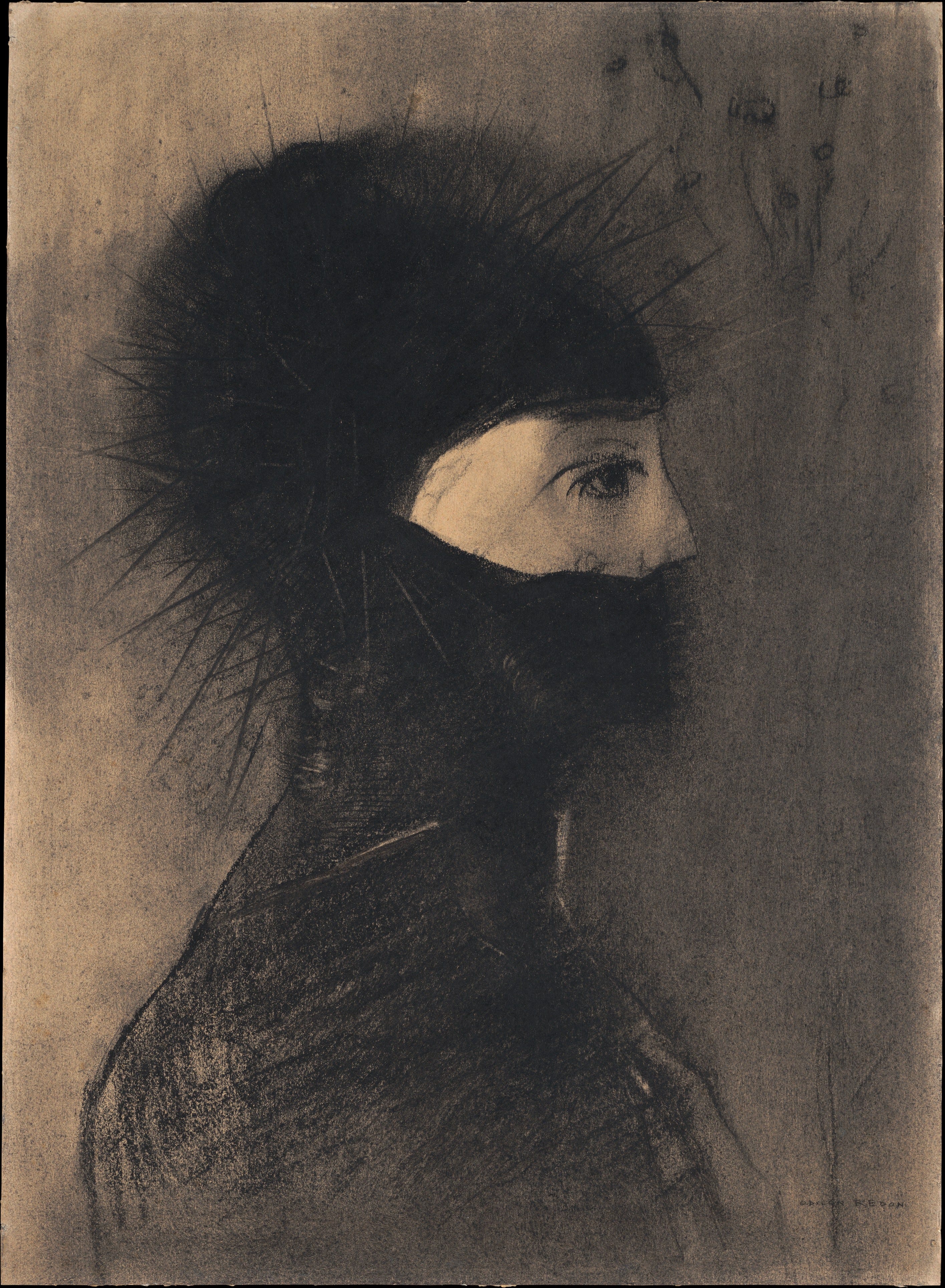
Armor, by Odilon Redon, Met Open Access
The Trump administration and Congress, they are not handling even the basics of airline safety at present. I am preparing my taxes and even that feels like a cheat of my time and energy.
Meanwhile, the war with Iran is historically unpopular with the American citizens, and this will not change as oil prices climb and the economy takes the asymmetrical hits the Trump administration did not and cannot anticipate, like the supply of computer chips needed for our current AI boom economy which is going to be severely foreshortened. Iran does not care to bargain with the US and Israel after having their leaders murdered during previous negotiations, something which was somehow unanticipated by those governments, as well as their control over the Strait of Hormuz. Also unanticipated was that the civilian population would not spontaneously overthrow their government, something that never happens as a result of bombardment. The Iranian government has issued an ultimatum in response to Trump’s ultimatum. The FT’s coverage on this is pretty decent, better than the American papers. Trump keeps trying to game the markets with false assurances about nonexistent talks with Iran, but is in the meantime is also threatening to forcibly open the Strait of Hormuz, which would be a blood bath for everyone involved. And the environmental cost so far of this war is unsustainable in the short and long term. Trump seems to want to turn the world into a killing jar.
We’re now at the place where communities are being told they might not get any power due to AI—Lake Tahoe has just been informed that this is their last year having 100% of their electricity supplied by their local utility, and that they will be losing 75% of it to supply local data centers. They have a year to figure it out. I find myself wondering if they can use the plug-in solar that American utility companies are trying to forestall for the thirty or so states eager to obtain these inexpensive, life-saving and easy-to-install panels. Contact your state representatives to support the introduction of these panels, essential also as AI is spiking all of our electrical bills.
I wasn’t aware, I must admit, of the US’s total blockade of oil to Cuba during this time until it resulted in turning off the country’s power altogether. The Chinese government has rushed solar power project materials to the country and has pledged more aid. Trump is meanwhile talking about doing what he’d like with the country as if it is his to decide. The most optimistic people I follow are hoping the current crisis expedites the move to renewable energy, even in the face of the sadistic opposition of the Trump administration, which is both opposing renewable energy projects and creating oil shortages simultaneously that are driving economies elsewhere to adapt quickly, moving away from using oil.
So for now I am in my house with my husband in America for now, reading the news, reading novels, writing a novel, reading essays and poems and trying to be useful, especially to him and to my mother in Maine, who is comfortable now, though I do not want to jinx that. Organizing realities. We do some meal planning, and we work quietly by ourselves, which feels cozy. I have spent too much of this life without him so it is nice to be home with him, day after day, on days like this.
III.
The other day I did some book shopping. I bought Pankaj Mishra’s From The Ruins of Empire: The Revolt Against the West and the Remaking of Asia, something my husband asked me for. I’ll be reading it after him.
For myself, I went to the bookstore looking for my friend Jung Yun’s new novel, All The World Can Hold, about a Korean American woman taking a cruise after 9/11 with her mother, to celebrate her mother’s chilsun, a Korean traditional age 70 celebration. It goes wrong, of course. And then I picked up Eradication, by Jonathan Miles; Brawler, by Lauren Groff; Maggie, Or, A Man And A Woman Walk To A Bar, by Katie Yee; and Thirst, by Marina Yuszczuk, translated by Heather Cleary, all courtesy of my research funds at work. I needed the Groff short stories, the Miles novel caught my eye with an embossed cover and an intriguing premise once I picked it up. The Yee was a novel my brother in law, who never used to read fiction, recommended to me, and that was next to the Yuszczuk, which is a vampire lesbian novel about a vampire who escapes ancient Rome for Buenos Aires and falls in love with a human woman who is there taking care of her mother dying of cancer in contemporary Argentina.
Perhaps you are helpless this way also, if so, please join me and enjoy.
I am very behind on telling you about some of the books sent to me in the mail. Dr. Rima Vesely-Flad’s The Fire Inside: The Dharma of James Baldwin & Audre Lorde responds to their life and works and the struggles we are all in with white supremacy through a Black queer Buddhist framework. Saleem Haddad’s new novel Floodlines is out now from Europa Editions, and represents a favorite new genre, the auntie battle royale over a family member’s art and legacy, here set in 2014 Iraq. Wayne Koestenbaum’s My Lover, The Rabbi, has the greatest title of the season perhaps that is also a perfect elevator pitch, just out from FSG Originals. Kill Dick, by Luke Goebel, from Red Hen Press, also has a great title and is dark academia under the palms, complete with a LA heiress to an opiate fortune dropping out of NYU and meeting a disgraced professor running a rehab scam. And then there’s the new Jordy Rosenberg novel, Night Night Fawn, which I blurbed happily, but honestly read Isle McElroy’s excellent review of the novel at The Atlantic.
Arcs are their own category, the Books of Tomorrow: John of John, by Douglas Stuart, out in May from Grove Press, is about being a lonely gay man looking for love among the other lonely men in rural Scotland on the Isle of Harris, which, I’ll be honest, was once a fantasy of my youth. It begins with the main character watching rugby players stretching; Isabel Waidner’s As If, a kind of Freaky Friday for queer adults, from FSG Originals in June; The Future Perfect, by Cay Kim, coming from Riverhead, also out this June; then there’s Deb Olin Unferth’s thrilling speculative fiction novel, Earth 7, also coming this June from Graywolf, which begins with something that doesn’t always get the most attention in post-apocalyptic novels: how to care for the children. And of course there’s American Hagwon by Min Jin Lee, a Korean diasporic treat which in its way is also about that question, how to care for the children?
IV.
And now some stories, essays and poems I think you’d find of interest.
Joy Williams wrote about the last days of Gene Hackman for Harper’s.
My friend Shauna Seliy has a story in the new VQR ghost story themed issue, “The Summer Kitchen.” I love this story and helped shepherd it to the magazine, and now I’m very happy to see it is in the world.
n+1 has a new short story from Karen Tei Yamashita. This was an exciting bonus as I went to the site looking for this story from Nicholas Hamburger first, “Simpleveld.” I believe because Jess Row was raving about it and he was right. Anyway, I never regret my subscription there.
The wonderful Elias Rodriques has a new short story in The Paris Review, “Lala and Waldy.”
Han Ong, who I’ve not seen in person in a million years, must be very close to having a short story collection ready to publish. I hope? I thought about this as I read his new and deliciously long story in the New Yorker, “My Balenciaga.” He’s published 9 stories there since 2019. I think that’s a collection but we’ll see. This also is a kind of battle of the aunties.
Much to love in the new Yale Review. Emma Copley Eisenberg has a new short story, “Lanternfly.” Dale Peck has a new essay, “Dogsbody.” And Aria Aber has a new essay also, “Night Knowledge.”
The new Sewanee Review has 7 new poems from Mary Ruefle and one from Michael Robbins. And the poet Mark Wunderlich at From the Wunderkammer has a profound and pleasurable contemplation of the work and life of Mary Ruefle.
Until next time,
Alexander Chee
Thanks for this. Lots of reading reccomendations I might make time for (there's just so much to read and do and there's also the reasonable desire to rest occasionally...).
Any mention of spring makes me think of Tom Waits:
You can never hold back spring
You can be sure that I will never
Stop believing
The blushing rose will climb
Spring ahead or fall behind
Winter dreams the same dream
Every time
It gets me through many a dark time - literal and figurative - and I find I need it more than ever of late!
The Lucy Ives framing is sharp, that the student who'd used the LLM thought non-detection proved literature was an outmoded construct. That's the argument that collapses what detection is for. The pairing with Kaitlyn Greenidge's note that the best novels don't pander feels like a steady answer to it. That the novel invites you into another consciousness, without contract about what that consciousness will be like, is exactly what the LLM cannot do.