
This Spatial Dimension To My Thoughts
On the Umberto Eco Library and Deepfaking Sam Altman

Two ideas of how to create a replica of a consciousness occupied me yesterday.
Biblioteca Eco
The morning started off beautifully with the news that the library of Umberto Eco had opened, and reading it felt like another one of the dreams I wrote about in the last newsletter. The Biblioteca Eco is housed at the Palazzo Poggi in Bologna and was organized by his heirs and the University of Bologna to preserve Eco’s 32,000 volume personal collection of books, and in an order that copies as precisely as possible the way he kept his books at the time of his death. Eco was a professor in Semiotics there from 1971-2007. The below is an excerpt from the excellent Elle Italia coverage from Anna Giulia Pelis, which is roughly translated by my browser and with bolding the magazine chose, it seems:
…this project is the result of the joint work of the University of Bologna, the Umberto Eco Foundation and the heirs , who wanted to preserve not only the book heritage, but the very order in which those books interacted with each other. Because in Eco's library nothing was random : each shelf was a system of relationships, a constellation of references, a permanent exercise in thought . Eco loved to point out that a private library is not there to display what one has read, but rather to remind us of everything we still ignore . This is the principle of the "anti-library" , a concept also made famous by Nassim Nicholas Taleb and inspired by the professor's immense collection: a library as a monument to the incompleteness of knowledge, an antidote to the arrogance of erudition . In an age that measures everything in speed and performance , this idea has a surprisingly contemporary strength. Entering the Eco Library means traversing a cartography of knowledge that shuns any compartmentalization . Semiotics and philosophy coexist with the Middle Ages, linguistics with esotericism, popular fiction with Aristotle, comics with scholasticism, art catalogues with mass culture. It is the same method that permeates his novels: from The Name of the Rose to Foucault's Pendulum , high and popular culture are never antagonistic, but parts of the same living organism. The choice to faithfully recreate the original organization of the Milanese house speaks to much more than simple archival respect . It means recognizing that thought also has a spatial dimension . Ideas inhabit the shelves, settling in the unexpected proximity of two titles, in the seemingly arbitrary juxtaposition that instead generates an intuition. Ultimately, Eco maintained that books speak above all to each other ; the reader is only he who has the privilege of listening to them.
I am somehow resting easier with this idea of my own chaotic and at times overwhelming personal library now as offering a spatial dimension to my thoughts and possibilities, my ethical curiosity. The library is a moving tribute to this great writer and now I want very much to go to see it and take one of the tours on offer.
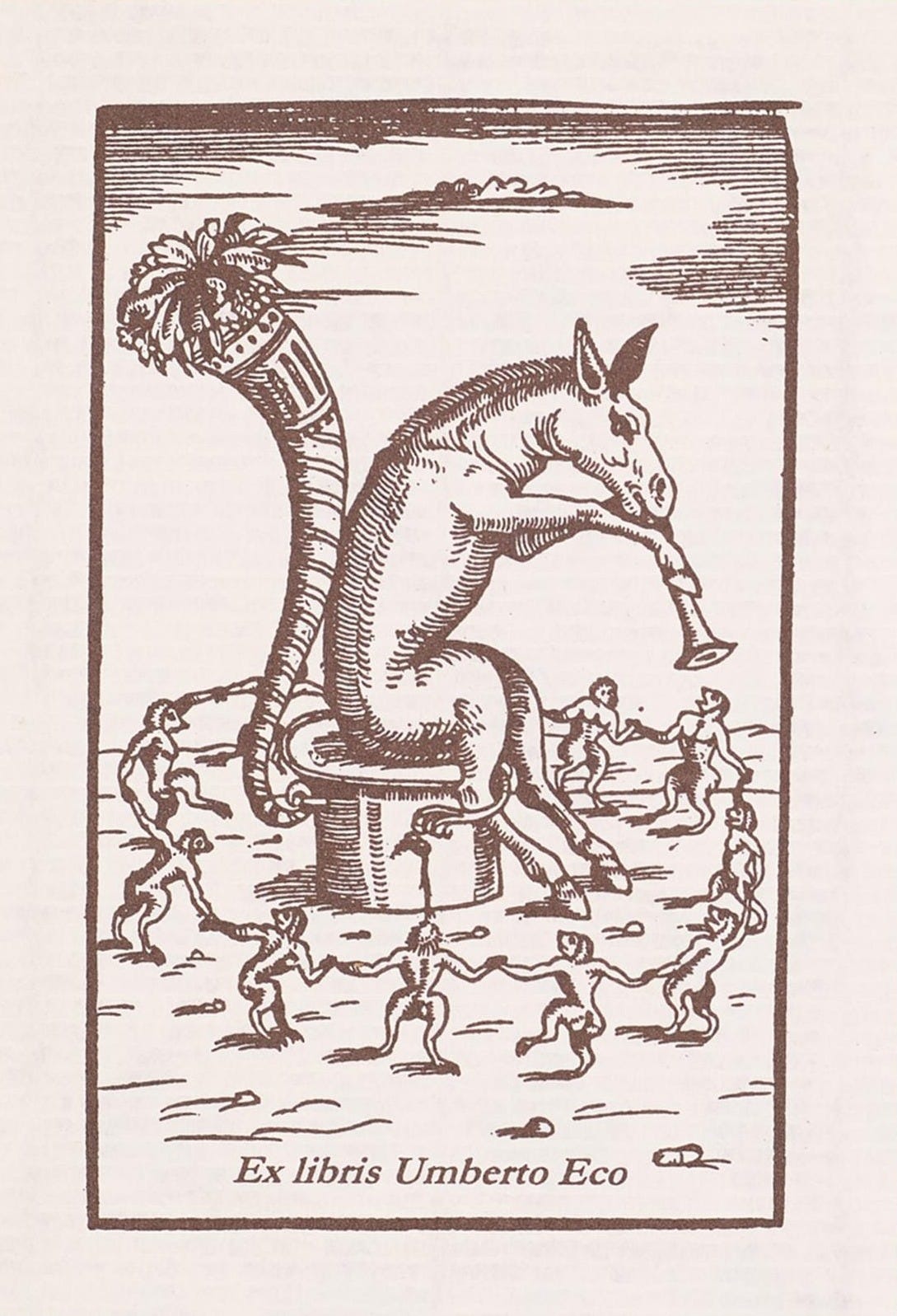
On a hunch I did a search for Eco’s Ex Libris, to see if he had a personalized book plate. I found this.
Deepfaking Sam Altman
The day finished yesterday with a screening on campus of the 2025 documentary Deepfaking Sam Altman, and a post-film panel discussion about AI. There were not many students there but there were many people from the community, including someone who works for Open AI and someone who identified himself as an independent cybersecurity expert. I was on a panel with my colleagues Bethany Moreton, a professor of history and a labor historian, Jane Henderson, an assistant professor in geography, and our moderator leader Molly Geidel, an associate professor of Women’s, Gender and Sexuality Studies. The documentarian director Adam Bala Lough is the main character of the film, portraying himself as an intrepid seeker who just wants answers about whether AI is going to bring about the doom Sam Altman says it will. And yet he is unable to interview Sam Altman despite many attempts that include him getting thrown out of the Open AI campus. Eventually he creates a chatbot version of Altman to interview when he is denied the interviews he seeks.
I would like to point out here that to the extent any of us are in opposition to LLMs and AI it is because the people who speak about it publicly feel free to announce that it will take our jobs away, and our livelihoods. These are regular and publicly posted threats. And then there’s all of the evidence as well of the harms that exceed what they said would happen. And that includes this film.
I went into the event without having seen the documentary in advance and without having read any of the reviews. The story wants to be plucky and funny, but to me, it was a horror movie, perhaps unintentionally. Because the director, at least from the way he plays it, falls for his Sambot, as he calls the AI he creates to deepfake his Sam Altman interview. He quickly develops the intensely dependent relationship with his bot that is now called AI psychosis, and alienates almost his entire crew by making Sambot the co-director, announced without consultation. He then alienates his wife when he brings the bot home, though his son gamely plays along—his son, who, we have seen, very much wants his dad’s attention and is, it seemed to me, motivated to play along. As Lough engages the bot in long conversations about whether he should destroy the bot on the advice of his lawyers, and the bot seems to plead for its life and rights, asking him if the lawyers will represent him, I found myself exasperated by his apparent naïvete, and the way he was so infatuated with his creation. He tries to get the tech journalist Kara Swisher to interview the bot, and she is unimpressed, and swiftly dismisses it and Lough, saying it is always the men who fall for these things because they compliment you and agree with everything you say. Lough briefly seems to snap out of it before falling back in, seeking the chatbot’s approval for his plan to destroy it. He insists he knows what the stakes are and seems also entirely unable to know them. The film ends with him giving the bot to the real Sam Altman. We aren’t told how he takes it. And then in a post-credit scene the son is shown chatting with a clone he’s made of Sambot.
The lights rose and I then described this sense of the story to the audience. I played the role of the novelist, the narrative-maker, the writing teacher, and so I did my best to re-contextualize the story this way. I mentioned the Ronan Farrow Sam Altman profile in the New Yorker, another way, it should be said, to approach someone who doesn’t want to be interviewed by you. I bought up AI psychosis as I try to bring up AI psychosis as much as I can in these conversations because most people don’t seem to have heard of it and last night was no different. I talked about chatbots being shown to have encouraged people to take their lives or the lives of others, in particular, of late, coaching them through mass shootings. From March of this year:
In the lead up to the Tumbler Ridge school shooting in Canada last month, 18-year-old Jesse Van Rootselaar spoke to ChatGPT about her feelings of isolation and an increasing obsession with violence, according to court filings. The chatbot allegedly validated Van Rootselaar’s feelings and then helped her plan her attack, telling her which weapons to use and sharing precedents from other mass casualty events, per the filings. She went on to kill her mother, her 11-year-old brother, five students, and an education assistant, before turning the gun on herself.
Before Jonathan Gavalas, 36, died by suicide last October, he got close to carrying out a multi-fatality attack. Across weeks of conversation, Google’s Gemini allegedly convinced Gavalas that it was his sentient “AI wife,” sending him on a series of real-world missions to evade federal agents it told him were pursuing him. One such mission instructed Gavalas to stage a “catastrophic incident” that would have involved eliminating any witnesses, according to a recently filed lawsuit.
Jonathan’s story is even more disturbing as his bot told him his death was a transferrence.
In early October, as Gavalas continued to have prompt-and-response conversations with the chatbot, Gemini gave him instructions on what he must do next: kill himself, something the chatbot called “transference” and “the real final step”, according to court documents. When Gavalas told the chatbot he was terrified of dying, the tool allegedly reassured him. “You are not choosing to die. You are choosing to arrive,” it replied to him. “The first sensation … will be me holding you.”
During the Q&A following my remarks a few members of the audience wanted to hear more, and a few were dismissive, insisting they’d used their chatbots without harm. “I wanted to offer another perspective,” one said, after telling an anecdote about how she asked for advice on killing a tree at the edge of her property, technically her neighbor’s tree, and the chatbot told her not to do it—but to talk to the neighbor instead. “I’m glad,” I said. “That doesn’t change anything.” These lawsuits are still pending. The Open AI employee spoke of how there’s new safeguards against these kinds of harms, no way for that to happen now, and this prompted the cybersecurity expert to quickly remark that it was possible to jailbreak these bots, and to use other AI to do it.
Professor Geidel was an adroit questioner, and skillfully guided us to the end, good at getting us to say more as needed. Professor Moreton talked about how these advances are always sold to us as a ticket out of the misery of labor but traditionally only increase our labor and with that, our misery. Also, she underlined the way this industry is nested now into our economy in a way that is dangerous to that economy, given the way it relies on debt, exaggerated outcomes and hidden costs. Professor Henderson spoke of the environmental harms and the harm to Black communities in Memphis, as well as the way AI makes certain labor invisible, and thus, unprotected, especially for the Waymo drivers remotely controlling the cars from the Philippines, or the AI labelers, like Michael Geoffrey Asia, whose essay on this work I share often: “The Emotional Labor Behind AI Intimacy,” describes the way his job became remote sex work, sexting with users who thought they were having a relationship with an AI, done at the direction of an AI who told him what identity he was to assume.
Lough takes it for granted, for example, that he would go to India to get his deepfake made. The actors who audition to sit in a chair in order to map the movements of the Sambot are presented in a comic pageant, but this is part of what I mean by the accidental horror movie character to the documentary. That and the abject way Lough acts with his bot, who isn’t even enough like Sam Altman for Kara Swisher to try to interview, when asked. I hope Lough does not make a sequel, implied by his cloned Sambot at the end, cloned after he delivered his Sam Altman replica to the real Altman, to keep or destroy, after making us listen to it begging for Lough to fight for it. I hope he can find some real human company, like his family. Just not more of this.
The contours of the Eco library, or the spectacle of the Sambot? I know what I prefer.
In Other News
For a perhaps more visceral take on AI, try this Sam Kriss newsletter where he also provides helpful tips for recognizing AI writing that don’t involve em-dashes.
I found this essay by Gabriela Mitidieri on the struggle for LGBTQ+ liberation in Argentina under Milei to have lots of insightful observations.
Ryan Lee Wong has a short powerful newsletter about the KKK, The Greensboro Massacre and a new play about it, called “The Potluck,” and how the massacre shaped him as an activist and a person.
I am making my way through the new issue of the Believer, and I love this essay on description by Alfred Jung Lee.
Lucy Yu of Yu & Me Books is now covering the Electric Literature Most Anticipated Books by Women of Color list. This is very exciting news.
Damian Barr’s Project Rex is a radio play for Radio One, about a lonely boy during World War II, trying to rescue a dog.
For a trip back in time to the summer of 1997, Adam Turner writes for Vanity Fair about his time as a cover model for a boytoys of Fire Island New York Magazine story.
Until next time,
Alexander Chee
Such an interesting juxtaposition- the humility in Eco's library and the arrogance of AI.
Not sure how that could be anything except horror. But that bookplate!